Compassionate Giving versus Responsible Giving
Many of us respond to homelessness with compassion, offering money, food, or clothing to individuals on the street.
But this form of giving can have unintended consequences:
- A significant proportion of people experiencing homelessness struggle with substance dependency.
- Cash can unintentionally fuel addiction and prolong time spent on the streets.
- Direct handouts can create dependency cycles, making it harder for individuals to seek structured help.
- It often bypasses professional support systems, such as social workers and rehabilitation programmes.
While compassionate giving comes from a good place, it can “enable chronic homelessness”.
Responsible giving, using Mi-Change vouchers, shifts the focus from short-term relief to long-term transformation. The Mi-Change voucher system, which is hosted by Zlto, has been developed in partnership with organisations like MES and U-Turn.
Mi-Change vouchers are a cashless way to give, allowing you a way to support people experiencing homelessness while connecting them to meaningful services.
Vouchers work
Unlike cash, vouchers are intentionally designed to:
- Meet immediate needs, like food, hygiene and shelter, with dignity.
- Connect people to support services. Every voucher redemption creates a point of contact with organisations that can help.
- Break cycles of dependency.
- Create a pathway off the streets.
- Reduce street-based begging
Understanding homelessness
1. The Size of the Challenge of Homelessness
Homelessness in South Africa is a growing and complex crisis, deeply rooted in poverty, unemployment, inequality, and urbanisation. According to recent national data, more than 55,000 people were experiencing homelessness in South Africa in 2022, a sharp increase from just over 13,000 in 1996. www.timeslive.co.za
Urban centres carry the greatest burden. Gauteng alone accounts for nearly half of the country’s homeless population, with the City of Johannesburg representing approximately 15.6% of all homeless people nationally.
However, these numbers are widely understood to be underestimates. Many people living in informal settlements, abandoned buildings, or so-called “hijacked buildings” are not fully counted in official statistics. These buildings, often unsafe and without basic service, have become a desperate alternative for those who cannot access housing. www.statssa.gov.za
The human cost of this crisis is severe. A tragic example is the 2023 Johannesburg inner-city building fire, where more than 70 people, many of them homeless, lost their lives in overcrowded and unsafe conditions. This disaster exposed the urgent need for systemic housing solutions and coordinated support services. en.wikipedia.org
What is needed to tackle homelessness?
Addressing homelessness requires far more than temporary relief. It requires:
- Integrated social services (shelter, healthcare, counselling, rehabilitation).
- Access to identity documents and social grants.
- Skills development and employment pathways.
- Affordable and safe housing solutions.
- Community involvement and behaviour change in giving.
Organisations like MES (Mould Empower Serve), U-Turn and Mi-Change play a critical role in this ecosystem by providing holistic, long-term interventions that move individuals from the street into sustainable independence.
2. The Impact of Giving Cash (Compassionate Giving)
Many South Africans respond to homelessness with compassion, offering money, food, or clothing to individuals on the street. While well-intentioned, this form of giving can have unintended consequences.
Research and programme experience show that large amounts of money are given directly to people living on the streets each year, estimated at over R200 million annually in Cape Town alone.
michange.org
However, studies and practitioner insights indicate that:
- A significant proportion of people experiencing homelessness struggle with substance dependency.
- Cash can unintentionally fuel addiction and prolong time spent on the streets.
- Direct handouts can create dependency cycles, making it harder for individuals to seek structured help.
- It often bypasses professional support systems, such as social workers and rehabilitation programmes.
While compassionate giving comes from a good place, it can “enable chronic homelessness” by sustaining life on the street rather than helping people exit it. This does not mean compassion is wrong, it means that how we give matters deeply. northernnews.co.za
3. The Impact of Vouchers (Responsible Giving)
Responsible giving shifts the focus from short-term relief to long-term transformation. One of the most effective tools supporting this approach is the Mi-Change voucher system which is hosted Zlto, developed in partnership with organisations like MES and U-Turn.
Why vouchers work
Unlike cash, vouchers are intentionally designed to:
1. Meet Immediate Needs with Dignity
Vouchers provide basic essentials, food, hygiene, and shelter, restoring dignity while addressing urgent needs.
2. Connect People to Support Services
Every voucher redemption creates a point of contact with organisations like MES, where individuals can access:
- Counselling.
- Rehabilitation programmes.
- Skills development.
- Work readiness opportunities.
3. Break Cycles of Dependency
By removing cash from the equation, vouchers reduce the likelihood of funds being used to sustain addiction or street-based survival.
4. Create a Pathway Off the Streets
Mi-Change emphasises that a voucher is not just a transaction, it is “the start of a journey” toward independence and reintegration.
5. Reduce Street Solicitation
By encouraging communities to give responsibly, vouchers help shift the system away from street-based begging toward structured support and development.
The Role of MES
MES (Mould Empower Serve) is a Christian social development organisation committed to restoring dignity and creating sustainable pathways out of homelessness.
Through its 4 Phase integrated model, MES provides:
- Safe accommodation and shelter.
- Daily meals and basic services.
- Counselling and rehabilitation support.
- Work readiness programmes.
- Skills training and employment pathways.
Most importantly, MES does not only respond to the symptoms of homelessness, it addresses the root causes, helping individuals rebuild their lives with dignity and purpose.
A Call to Action: From Compassion to Impact
Homelessness is one of the most visible and pressing challenges in our cities. While the scale of the problem can feel overwhelming, every individual has the power to make a meaningful difference.
When you give:
- Choose responsible giving over reactive giving.
- Support organisations like MES that provide long-term solutions.
- Use tools like Mi-Change vouchers to connect people to real help.
Compassion changes lives; but responsible compassion transforms futures.
Why support the homeless cause?
Homelessness is one of the most visible and pressing challenges in our cities. While the scale of the problem can feel overwhelming, every individual has the power to make a meaningful difference.
Many South Africans respond to homelessness with compassion, offering money, food, or clothing to individuals on the street. While well-intentioned, this form of giving can have unintended consequences. The opportunity to contribute meaningfully to homeless is made possible trough the Zlto platform. Zlto enables South Affricans to choose responsible giving over compationate giving.
The Zlto platform provides a transparent, trustworthy and accountable as an enabler for donations to be made digitally and it interacts with the key enablers who work with people experiencing homelessness as illustrated below.
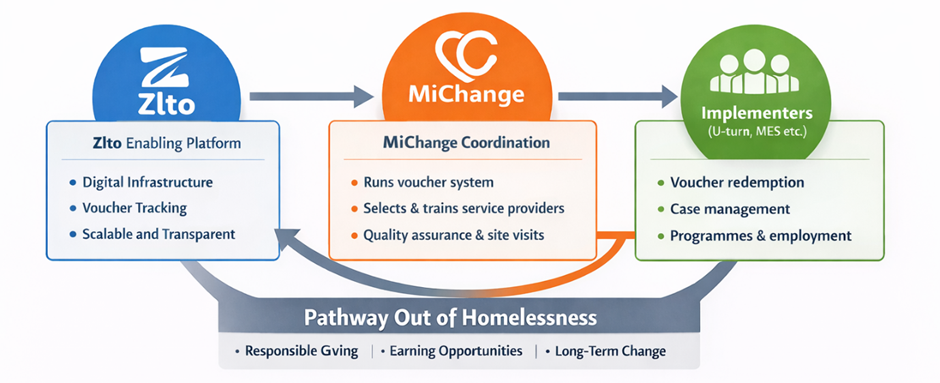
The benefit of this approach is that each part contributes a different strength. Zlto provides the technology and scalability. MiChange provides the voucher model, partner network, training and quality assurance. Service providers deliver the human support and developmental pathway. Together, this creates a model that is more accountable than cash giving, more structured than one-off relief, and more likely to support real movement out of homelessness because it links compassion, services and progression in a coordinated way.